Will 2026 finally bring the rate relief that homebuyers and borrowers have been waiting for? After years of elevated interest rates, millions of Americans are closely watching every Federal Reserve announcement, hoping for a clearer path forward. The good news is that most experts agree rates are heading lower—but how far and how fast remains the million-dollar question shaping the interest rate outlook 2026.
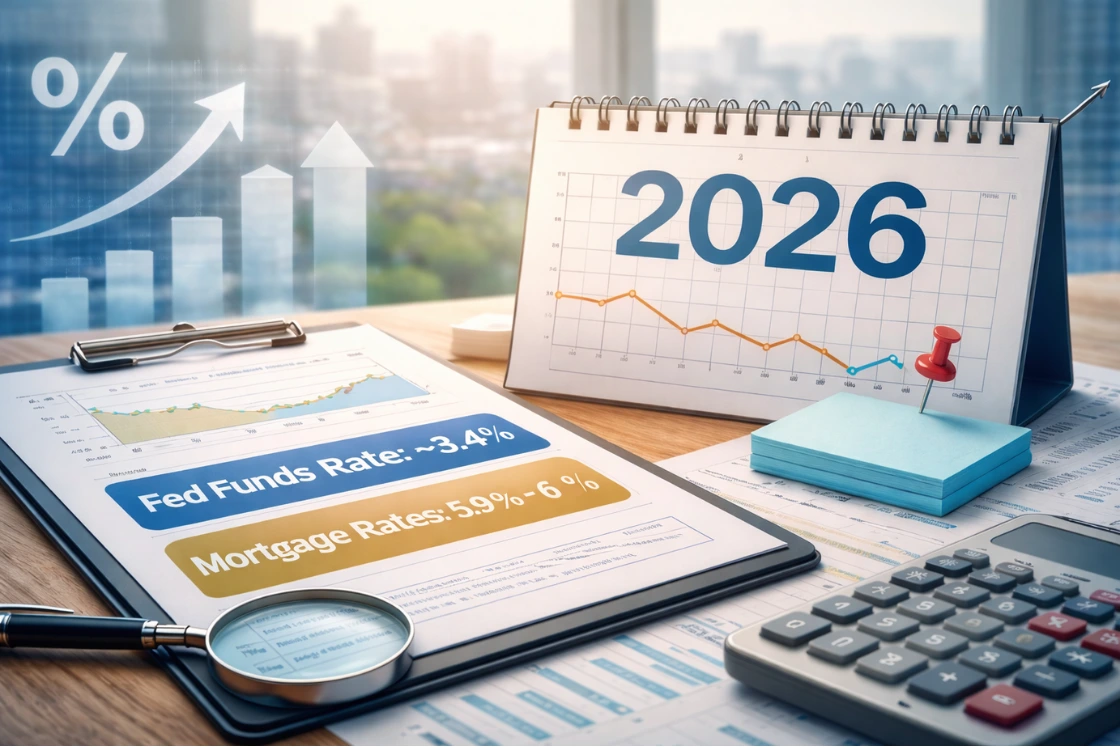
Definition: The interest rate outlook for 2026 refers to expert predictions about where the Federal Reserve’s policy rate and mortgage rates will land by the end of next year. Current forecasts project the fed funds rate at approximately 3.4% and 30-year mortgage rates between 5.9% and 6.4%.
In this comprehensive guide, we break down what leading financial institutions predict, the economic factors driving these forecasts, and what it all means for your financial decisions in the coming year.
What Will the Federal Reserve Do With Interest Rates in 2026?
Short Answer: While the Federal Reserve projects a conservative path, major institutions like Goldman Sachs expect up to 2-3 cuts in 2026
Understanding where interest rates are headed starts with the Federal Reserve. The Fed’s monetary policy decisions ripple through the entire economy, affecting everything from credit card APRs to mortgage rates.
What Does the Fed’s Dot Plot Predict for 2026?
Definition: The dot plot is a chart showing where each Federal Reserve official expects interest rates to be in the coming years.
According to the most recent Summary of Economic Projections:
- End of 2025: Fed funds rate projected at ~3.6%
- End of 2026: Fed funds rate projected at ~3.4%
- Long-run neutral rate: ~3.0%
This represents a gradual easing from the current target range of 4.00%-4.25%, signaling that policymakers anticipate continued progress on inflation without the need for aggressive rate cuts.
How Many Fed Rate Cuts Are Expected in 2026?
Expected Fed Rate Cuts in 2026:
- Goldman Sachs forecast: 2 cuts in March and June 2026
- Bank of America forecast: 2 cuts in June and July 2026
- Consensus estimate: 2-3 cuts totaling 50-75 basis points
These cuts would bring the fed funds rate to a terminal range of 3.0% to 3.25%, according to major financial institutions.
What Is the Terminal Rate for 2026?
Definition: The terminal rate is the level at which the Fed believes interest rates are neither stimulating nor restricting economic growth—also called the “neutral rate.”
Key Terminal Rate Facts:
- Current projection: 3.0%-3.25%
- Expected arrival: Second half of 2026
- Implication: Rates will stabilize, not continue falling indefinitely
Fed Chair Jerome Powell has emphasized that policy decisions aren’t on a preset course, comparing the current environment to “driving in the fog”—requiring caution and flexibility.
What Will Mortgage Rates Be in 2026?
Short Answer: Most experts predict 30-year fixed mortgage rates will range between 5.9% and 6.4% in 2026, with the possibility of touching the high-5% range by late year if inflation continues cooling.
While the Federal Reserve sets short-term rates, mortgage rates follow their own path, primarily tracking longer-term Treasury yields.
2026 Mortgage Rate Predictions by Institution
| Institution | 2026 Forecast |
|---|---|
| Fannie Mae | 5.9% by year-end |
| Mortgage Bankers Association | 6.4% average |
| National Association of Realtors | 6.0% average |
| Realtor.com | 6.3% average |
Fannie Mae projects 30-year mortgage rates will start 2026 at around 6.2% before declining to 5.9% by year-end. If you’re exploring conventional mortgage options, these projections suggest 2026 could bring improved affordability compared to recent years.
Will Mortgage Rates Drop Below 6% in 2026?
Short Answer: Possibly. Fannie Mae projects rates could reach 5.9% by late 2026, but most analysts expect rates to hover around 6% rather than dropping significantly lower.
Factors That Could Push Rates Below 6%:
- Inflation falling consistently below 2.5%
- Faster-than-expected Fed rate cuts
- Economic slowdown reducing Treasury yields
Factors That Could Keep Rates Above 6%:
- Sticky inflation, especially in services
- Tariff-related price pressures
- Elevated government deficits
Why Don’t Mortgage Rates Fall When the Fed Cuts Rates?
Definition: Mortgage rates track the 10-year Treasury yield, not the federal funds rate. The spread between Treasuries and mortgages typically ranges from 1.5 to 2.5 percentage points.
When Treasury yields remain elevated due to inflation concerns or deficit worries, mortgage rates stay high even as the Fed cuts short-term rates. This disconnect explains why mortgage rates have been “sticky” despite recent Fed easing.
What Economic Factors Will Affect 2026 Interest Rates?
Three primary economic factors will determine whether rates fall as expected.
1. Inflation Trends
Key Metric: Core PCE inflation currently runs at ~2.8% year-over-year, above the Fed’s 2% target.
Inflation Trajectory:
- Current (2025): ~2.8%-3.0% PCE
- Projected 2026: ~2.5%-2.6% PCE
- Fed Target: 2.0%
2. Labor Market Conditions
Current Status: Unemployment at ~4.3%, characterized as a “low-hire, low-fire” environment.
This labor market stability supports the “soft landing” scenario that most forecasters are banking on. If job losses accelerate significantly, however, the Fed might cut rates more aggressively—which could push mortgage rates lower faster than expected.
3. Treasury Yields
Key Fact: For mortgage rates to drop below 6%, the 10-year Treasury yield would need to fall to approximately 3.5%.
Current Treasury Dynamics:
- 10-year yield: ~4.1%-4.2%
- Required for sub-6% mortgages: ~3.5%
- Forecast: Likely to remain around 4% through 2026
What Do Major Financial Institutions Predict for 2026?
Goldman Sachs Forecast
| Metric | Goldman Sachs Projection |
|---|---|
| Terminal Fed Funds Rate | 3.0%-3.25% |
| Rate Cut Timeline | March and June 2026 |
| U.S. GDP Growth 2026 | 2.0%-2.5% |
| Inflation Outlook | Cooling to ~2% underlying |
What Are the Possible Scenarios for 2026 Interest Rates?
Three Interest Rate Scenarios for 2026:
| Scenario | Fed Funds | Mortgage | Probability |
|---|---|---|---|
| Best Case | 2.75%-3.0% | 5.5%-5.75% | ~20% |
| Base Case | 3.25%-3.5% | 5.9%-6.2% | ~60% |
| Worst Case | 3.75%-4.0% | 6.4%-6.75% | ~20% |
How Will 2026 Interest Rates Affect You?
Impact on Homebuyers
Key Statistic: A rate drop from 7% to 6% means more than 5 million additional households can afford a median-priced home (NAR data).
Even a modest decline from 7% to 6% mortgage rates means more than 5 million additional households can afford a median-priced home, according to National Association of Realtors data. Use our mortgage calculator to see how different 2026 rate scenarios could impact your monthly payment.
Impact on Refinancing
Rule of Thumb: Refinancing typically makes sense if you can reduce your rate by at least 0.5%-1% and plan to stay in your home long enough to recoup closing costs.
Calculate your break-even point by dividing closing costs by monthly savings to determine if refinancing makes financial sense for your situation.
Frequently Asked Questions About 2026 Interest Rates
What will interest rates be in 2026?
Answer: The Federal Reserve projects the fed funds rate at approximately 3.4% by the end of 2026. Mortgage rates are forecast between 5.9% and 6.4%, according to Fannie Mae and the Mortgage Bankers Association.
Will mortgage rates go below 6% in 2026?
Answer: Possibly by late 2026. Fannie Mae projects rates could reach 5.9% if inflation continues cooling. However, most forecasters expect rates to hover around 6% rather than dropping significantly below that level.
How many Fed rate cuts are expected in 2026?
Answer: Most economists expect 2-3 rate cuts in 2026, totaling 50-75 basis points. Goldman Sachs forecasts cuts in March and June; Bank of America expects June and July.
Should I wait to buy a house until rates drop in 2026?
Answer: Not necessarily. Waiting risks facing higher home prices if lower rates increase buyer demand. Many experts recommend buying when you find the right home at an affordable price, then refinancing if rates decline. First-time buyers may also benefit from exploring first-time homebuyer programs that offer competitive rates and flexible terms.
Why aren’t mortgage rates falling faster with Fed cuts?
Answer: Mortgage rates track the 10-year Treasury yield, not the Fed’s short-term rate. Treasury yields remain elevated at approximately 4.1% due to inflation concerns and deficit worries, keeping mortgage rates high despite the Fed easing.
Is 2026 a good year to refinance my mortgage?
Answer: If your current rate is 6.5% or higher and rates fall as expected, 2026 could offer good refinancing opportunities. Calculate your break-even point by dividing closing costs by monthly savings to determine if it makes financial sense.
Key Takeaways: 2026 Interest Rate Outlook Summary
What We Know:
- Fed funds rate expected to reach ~3.4% by the end of 2026
- Mortgage rates forecast between 5.9%-6.4%
- Rate cuts likely: 2-3 cuts totaling 50-75 basis points
- Terminal rate projected at 3.0%-3.25%
- Inflation needs to continue cooling for forecasts to hold
What You Should Do:
- Monitor Fed announcements and inflation reports
- If you’re considering buying a home, get pre-approved for a mortgage now so you’re ready to act quickly when opportunities arise in 2026
- Calculate potential refinancing savings at various rate levels
- Stay flexible — economic conditions can shift quickly
- Don’t wait for “perfect” rates if you find the right opportunity
The 2026 interest rate outlook suggests cautious optimism. Rates are expected to decline gradually rather than dramatically. Being informed and prepared puts you in the best position to make smart financial decisions regardless of where rates ultimately land.